












Alto rail project must stop, eastern Ontario residents say

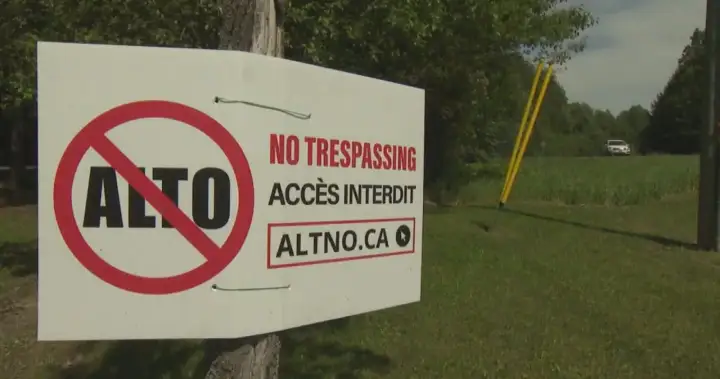
Some residents of Eastern Ontario say they are feeling “betrayed” after the federal government announced it would consider a high-speed rail stop in Kingston, Ont.

Federal Transport Minister Steven MacKinnon announced Monday that a southern route option would be considered, linking Ottawa and Peterborough. The federal government has mandated seven stops so far: Toronto, Peterborough, Ottawa, Laval, Que., Montreal, Trois-Rivières, Que., and Quebec City.
MacKinnon said the corridor, including a potential stop in Kingston, will significantly cut travel times between major cities and provide a low-emissions transportation option.
“When I first heard about the project back in January, when I heard about the southern route, it was devastating. I remember falling to my knees in my house, wondering what was going to happen and whether they were going to just plow through these communities,” Sarah McMullen said.
McMullen lives and works in Scarborough but spends a considerable amount of time at a family cottage in Sydenham, in Frontenac County. She told Global News Monday that emotions were riding high after learning the path for a high-speed rail project could cut right through her land.
“It is where my dad taught me how to fish. It’s where my dad and I used to walk down the Cataract Way Trail together, watching like the butterflies landing on the milk weed, or what the muskrat was up to and watching like the birds,” she said.
Alto, the Crown corporation overseeing the project, said it was instructed by the federal government to assess a southern route option between Ottawa and Peterborough including a “potential stop in Kingston.”
Alto said this would reduce travel times between Kingston and Toronto from three hours to approximately 90 minutes. The possible stop could also connect with the Via Rail station in Kingston.
Public consultation reports released by Alto on Monday say 58.8 per cent of people living along the proposed high-speed rail corridor between Quebec City and Toronto expressed some level of support for the project.
MacKinnon said he was “acting on what we heard” in public consultations in suggesting an additional stop in Kingston.
“This is a strong indication of preference for one route over another,” he said, though he stressed no final decision has been made.
McMullen said she’s not convinced.
“They’re making it seem like they are answering our questions and that stopping in Kingston is the answer to everyone’s complaints in Eastern Ontario,” she said.
Get daily National news
Get daily Canada news delivered to your inbox so you’ll never miss the day’s top stories.
She is part of the community group Save South Frontenac, which released its own polling on residents of South Frontenac municipalities. According to their poll, 41.6 per cent do not support the southern route and an additional 55.8 per cent do not support the high-speed rail project at all.
The majority of residents said they were not given enough information from Alto or the federal government to confidently understand how their community would be impacted.
“It doesn’t make sense,” McMullen said. “The math isn’t mathing.
“Are you taking the statistics that encompass everyone from Toronto and Montreal and saying, OK, 40 per cent is for this project? But that doesn’t actually reflect the level of opposition that exists, perhaps, outside of these cities.”
Peter Miasek, a representative for Transport Action Ontario, said the advocacy group welcomes the announcement that another route will be considered through Kingston, but is concerned about what he considers a lack of transparency throughout the entire project.
“We need a solid business case for this thing,” he told Global News. “We’re still on the fence on high-speed rail because we’ve seen no business case.”
Alto has said its high-speed rail project expects 24 million passengers annually by 2055. But an independent study conducted by researchers from McGill University suggests that number is likely between eight and 10 million.
“We don’t have the information, because even Alto doesn’t have the information,” Anthony Jenkins told Global News as he protested in Kingston outside Monday’s announcement. “There are no studies, there is no data to support their assumptions of ridership cost and the general utility of the project 25 years into the future.”
One major concern for residents along the corridor is how the rail line could hinder their access to other parts of the region, as well as how the line could impact emergency services and other utilities that need to cross it.
“What most people don’t understand is that what they want to do is build essentially an impenetrable barrier that neither man, beast or vehicle can cross from Quebec City to Toronto, with only a very few designated access points at the stations and a greatly reduced number of crossings,” Jenkins said.
Miasek said he is advising the federal government and Alto to consider top speeds of 170 km/h instead of the proposed 300 km/h, which would allow for more flexibility with other kinds of transportation.
“The magic about 170 is that you don’t need to gate, separate or close every road that crosses the tracks,” he said.
“We strongly believe that some sort of improved rail service is needed for all the obvious reasons, congestion relief, economic uplift, no person left behind, equity, environmental, all that stuff,” he said. “I mean, obviously something has to happen. But we’d like to see a broader range of options studied.”
Many residents, like McMullin, don’t want to leave South Frontenac, but those who do, real estate agent Kevin Wells said, may have trouble finding a buyer for homes.
“Even though this proposed route remains vague, it is already negatively affecting our local real estate market,” he told Global News. “I have seen many buyers decide to enter a ‘holding pattern’ and choose not to buy due to the possibility of being impacted by this train.”
The Realtor, with 16 years of experience, said he recently lost a buyer from Toronto who was interested in a 95 acre farm.
“They backed out solely because of the uncertainty surrounding how ALTO might affect the property,” he said in an email.
“I am deeply committed to full disclosure,” he added. “We want all parties involved — both buyers and sellers — to have the accurate information they need to make an educated decision on one of the largest financial purchases of their lives.
“Unfortunately, the secrecy and misinformation surrounding this project make it impossible for us to properly guide our clients or answer their valid questions.”
While Wells is concerned about drawing people to the region permanently, Kingston’s Chamber of Commerce said high-speed rail will help drive commuters and tourists into the city.
“For businesses, the improved rail connectivity really means better access for our customers, our talent to come here, investment and tourism,” Karen Cross, CEO of the Greater Kingston Chamber of Commerce, told Global News. “Imagine the ability to go to Ottawa and back on the same day, or Toronto and back on the same day. It’s phenomenal.”
Kingston Mayor Bryan Paterson told Global News he was “encouraged” by the federal government’s announcement to assess the feasibility of a stop in Kingston.
He said he has seen support for high-speed rail grow in the municipality as long as Kingston is included, but recognizes some community members still have concerns.
“I’m very sensitive to those concerns,” he said. “We’ve been trying to work together to find a good way forward. And so obviously we’re asking for a stop on the Alto line, but also finding that route that would minimize any adverse environmental impacts.”
He said the ideal would be to have the rail line follow as close to Highway 401 as possible to limit ecological degradation.
“We think that still makes a lot of sense at least at least in our area and so we’re certainly continuing to push for what we think is a good route option,” he said.
Miasek said a route along Highway 401 or the existing rail corridor would be the ideal for many, but said that could come with its own host of limitations including speed.
“I think most people would prefer a route that ran through more urban areas,” he said.
Construction of the first phase of the roughly 1,000-km rail line is set to begin in 2029 or 2030.









 AI & Creator Equipment