










A Map and Timeline of the History of Buddhism in Asia

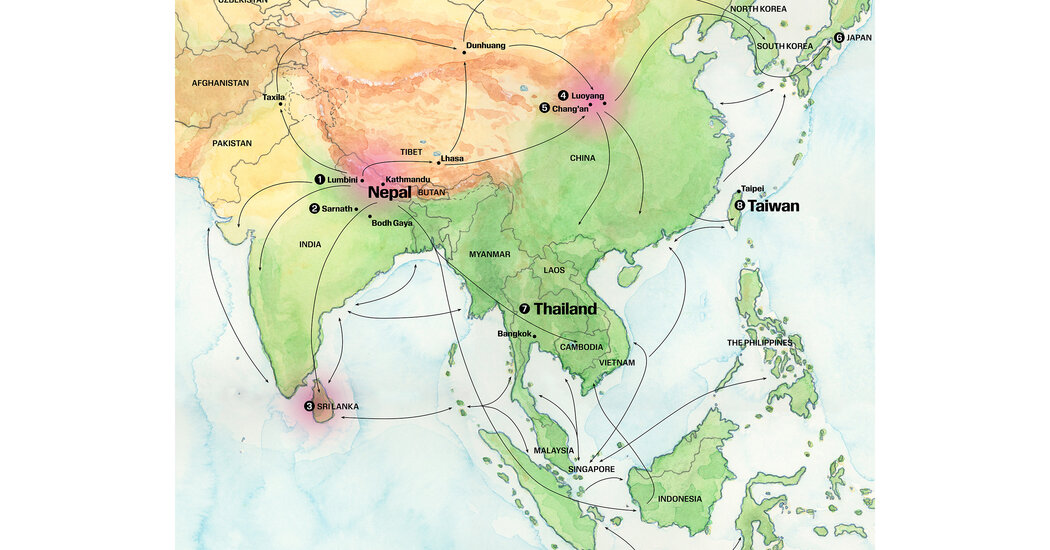
Seventh-Sixth Century B.C.
Siddhartha Gautama, the founder of Buddhism, is born in Lumbini ❶, in current-day Nepal, circa 563 B.C. (This is one of two years his birth is commonly dated to, the other being 623 B.C.) After his awakening, at around age 35, he delivers his first sermon, outlining the causes of and end to suffering, in Sarnath, India ❷, and the doctrine begins to spread across the subcontinent.
Third Century B.C.
Theravada Buddhism, which traces its roots to the early Buddhist communities of India, travels to Sri Lanka ❸ and eventually all of Southeast Asia. Around the same period, Ashoka the Great, the ruler of India and a Buddhist convert, erects a pillar in Lumbini to commemorate the Buddha’s birthplace.
First Century B.C.
Mahayana Buddhism, another branch of the religion, emerges and gradually expands across the Asian continent.
First Century A.D.
Two Indian monks establish the first Buddhist temple in China on the eastern edge of the Silk Road in Luoyang. ❹
Sixth Century
A new movement, Vajrayana, or Tantric, Buddhism, which originated in northern and eastern India, begins to spread — predominately to northern and eastern Asia, including Nepal — while the Mahayana movement, combined with Taoism and Confucianism, is popularized in China.
Eighth Century
The Chinese city of Chang’an ❺, the world’s largest metropolis at the time, is the primary site for the translation of Buddhist texts.
Ninth Century
A Japanese monk founds a Buddhist temple on Mount Koya ❻, introducing the Shingon strain, imported from China, to Japan.
13th Century
The Theravada orthodoxy spreads from Sri Lanka to Southeast Asia and ultimately becomes the predominant strain in Thailand. ❼
14th Century
The Islamic conquests of the Indian subcontinent and the resurgence of Hinduism, among other factors, lead to the Buddhist tradition being all but abandoned in its birthplace.
17th Century
Buddhism arrives in Taiwan ❽ with Chinese settlers.
20th Century
China’s Cultural Revolution, beginning in 1966, bans religious worship in the country. That policy begins to gradually loosen after Mao Zedong’s death in 1976.
21st Century
Buddhism has nearly 330 million adherents worldwide and is the majority religion in seven countries across the Asian continent.