













‘Witness’ Tree Outside Abraham Lincoln’s Former Home Irreparably Damaged

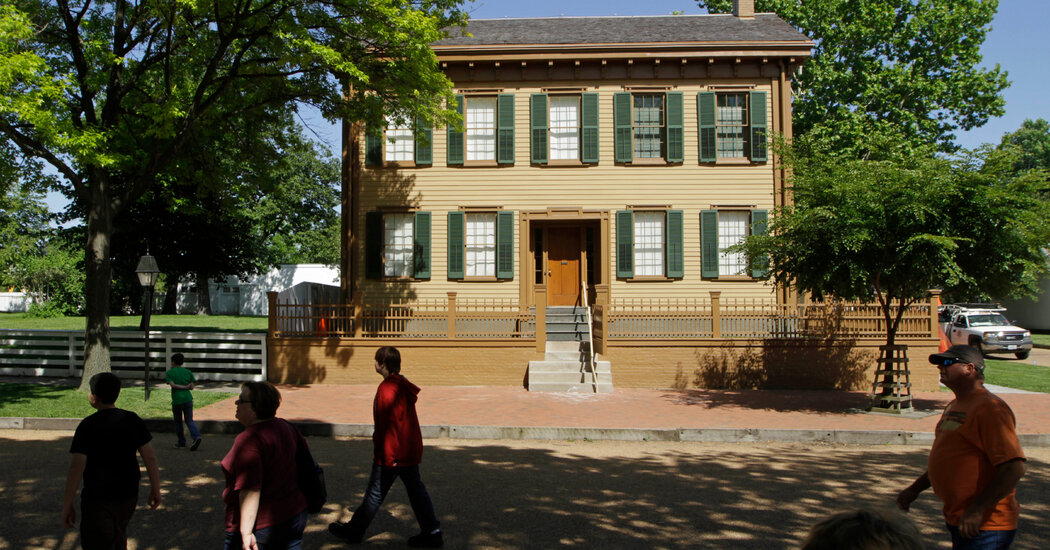
Severe storms on Thursday irreparably damaged what is believed to be the last remaining “witness” tree at a home in Springfield, Ill., dating back to the time that Abraham Lincoln lived there.
According to a National Park Service employee, the tree, an American linden, was damaged by winds, which gusted to at least 60 miles per hour. Pictures posted to social media show the tree with its upper half toppled over.
Lincoln bought the home in January 1844 and lived there for 17 years. During that time, he set up his own law practice, welcomed and buried his second child, was elected to the House of Representatives and eventually to the White House in 1860.
He left the home for the White House early in 1861.
The home, which was constructed starting in 1839, was originally 1.5 stories tall and had five rooms, but was remodeled several times by Lincoln.
Trees and shrubs were a part of the fabric of the neighborhood, serving to beautify the area and provide shade and privacy.
In 1856, Springfield residents passed a tree-planting ordinance to fill the city streets and yards with a variety of flora, according to the Park Service.
There are trees connected to Lincoln at other locations. They are often referred to as “witness” trees because they were present during moments of historical importance and have survived to modern times.
One of the most well-known is a honey locust, which is about 100 yards from where he delivered the Gettysburg Address in 1863. Storms heavily damaged the tree in 2008 but it survived, according to The York Daily Record of Pennsylvania.
The significance of a natural connection to the past can bridge the gap between eras more than a plaque or a statue, said Kate Masur, a professor of history at Northwestern University, who has studied Lincoln.
“These are kind of natural monuments,” Professor Masur said. “I find it really powerful to be in the presence of these trees that were alive at that time, maybe, in part, because they’re living things.”
Professor Masur said the destruction of the linden tree was a reminder that these artifacts are currently “under siege” at a time that the federal government seeks to reshape national parks and monuments.
Last year, President Trump complained in an executive order that the Smithsonian Institution had advanced “narratives that portray American and Western values as inherently harmful and oppressive.”
The order sought to curb the institution’s independence.
On Friday, a federal judge temporarily blocked the Park Service from removing or revising signs, films and other materials at national parks across the country to comply with the executive order.
We are becoming less familiar with the past, Professor Masur added.
“No tree can live forever, and I think it’s a sign of the passage of time, and our growing distance from the era of Lincoln and the Civil War,” Professor Masur said. “Nothing’s permanent.”