












Traveling the Hudson River Valley With Art as a Guide

The American art scene changed indelibly when Thomas Cole took a sketching trip to the Hudson Valley in 1825. Cole’s finished paintings were unusual. His subjects weren’t the saw-toothed Alps, nor the Italian countryside decorated with ancient ruins. Suddenly, the Catskills’ stair-step skyline, its emerald forests, its silver-mirror creeks, its waterfalls and awesome clouds were art. This, finally, was American landscape art.
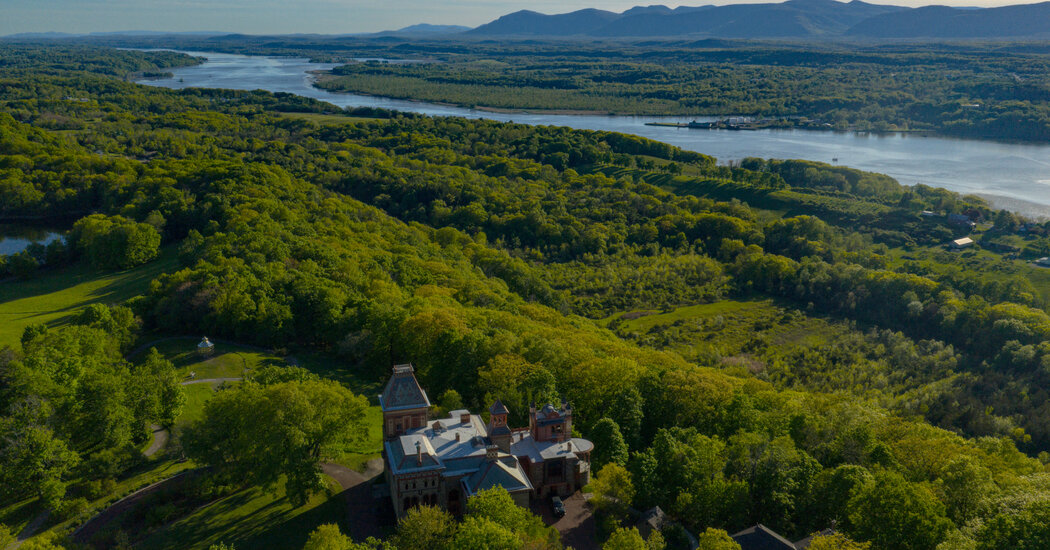
Frederic Church, who was born one year later — 200 years ago this month — and would later become Cole’s student, made his own name as a painter of dramatic, distant landscapes, but he always returned to the Catskills. When his monumental 10-foot-wide painting, “Heart of the Andes,” sold in 1859 for the record-breaking sum of $10,000, Church used the proceeds to purchase a farm in Hudson, N.Y. The grounds included a spot called Red Hill, where he had gone sketching as a young man. Eventually, he acquired a total 250 acres in the area and built an estate called Olana, all of which is now preserved as a historic site.
As someone who grew up in upstate New York, and then became an art historian, I knew these stories, but perhaps too well. I rushed past the period during graduate school to get to the shocks of the new — to modernism and photography.
The thing that finally called me back to this landscape, and the artists who came to be known as the Hudson River School, was an unusual paper published recently in an ecology journal. The authors proposed using 150-year-old paintings to study environmental change. Historical ecology examines the interaction of nature and human beings over time, and the paper showed that some paintings could provide trustworthy information about shifts in biodiversity and forest complexity.
But the authors, who came from the worlds of science and art history, weren’t just flattening art into data; understanding what the artists were doing, and why, was essential to the analysis.
It was energizing to feel as if the arts had collided with environmental science — and that the paintings themselves could contribute.
Searching for a Painted Past
With the help of the Hudson River School Art Trail, I mapped out an afternoon’s drive through the landscape made famous by paintings. I started along Catskill Creek, where Church had drawn Cole’s son against a background of lush summer growth. In early March, I found myself in the gray gravelly parking lot of an auto detailing shop, straining to see the water under a bridge.
I’d dreamed I could step directly into the past, like Rip Van Winkle in reverse. Washington Irving’s short story was published in 1819, its Catskills’ magic an intoxicating lure for visitors. But as Church and Cole knew, you didn’t have to fall asleep for 20 years to notice changes in the region. Subtle shifts, whether meteorological or geographical, often inspire painters to revisit the same views. Change is also the reason that Hudson River School paintings may be useful to ecologists today.
The engine of my rental car strained when I turned into the mountains, following Kaaterskill Creek toward the site of the former Catskill Mountain House. I parked at North-South Lake, which in another century had been a popular painting spot. Now, at least in summer, it’s a popular campground. As I walked the quiet, wooded trail, icicles melted, and a white-tailed deer shaded silently into a background of trees.
The colonnaded Greek Revival hotel no longer stands, but in period illustrations it appears to hover perilously on a cliff overlooking the broad valley. Despite the stupendous view, I was transfixed by the graffiti at my feet: 200 years of names and dates chiseled into the red rock, looking uncannily like a giant gravestone. I searched for Church and Cole until I realized that their names were already everywhere else in this landscape.
Nearby trails lead to other painting sites, Artist’s Rock, Sunset Rock, and the shocking 260-foot drop of Kaaterskill Falls, the highest two-tiered waterfall in the state. Far below, there’s the Hudson Valley with its farms and orchards, but also its auto detailing shops and parking lots. I kept wondering: What part of this is art? What part is nature?
Surveying the Understory
Dana Warren, the lead author of the ecology paper and a professor at Oregon State University, is an irrepressible presence, even on a Zoom screen. When we spoke before my trip, his strawberry blonde hair faintly glowed in his sunny office.
Dr. Warren told me he’d been dreaming of a project like this ever since graduate school at Cornell University, in Ithaca, N.Y., 20 years ago. There, he was studying the effect of woody debris on forest streams. But, he said, because there is little old-growth forest left in the Northeast, he struggled to identify a “reference condition,” or historical benchmark, against which he could compare his contemporary data.
When Dr. Warren saw the work of the Hudson River School painters, he was “jazzed,” because they had painted some of the more distant reaches of the Adirondacks and the Catskills before those forests were logged. But when he proposed using art in his study, a senior faculty member dismissed the idea, telling him, “You can’t trust any of it.”
Typically, even art historians resist the idea of using paintings as objective documents. Instead, we prefer to emphasize the artist’s personal vision, their unique way of filtering the objective world through subjective experience. If the artist simply copies the landscape, where’s the art?
It was Eleanor Jones Harvey, a senior curator at the Smithsonian American Art Museum, who ultimately affirmed Dr. Warren’s hunch — and, later, convinced me — that there might be a middle ground between these hardened ways of thinking. It’s true that this group of painters sometimes set invented scenes in familiar places or brought distant features close together in composite views. But, she told me, the sketches some of them made from nature were “grounded in accurate observation.”
Dr. Warren’s enthusiasm doubled when I asked if he could talk me through the artwork used in the study. His slides filled my screen. It could have been an art history lecture, except his annotations highlighted areas of forest complexity and canopy variability instead of vanishing points and compositional strategies.
The benefit of using artwork for historical studies, Dr. Warren explained, is that they can show what’s happening in the forest as a total system. Other historical forest-ecology research tends to rely on “witness trees,” large canopy trees that were recorded by surveyors as property boundaries in the colonial era. Dr. Warren said, “There’s a lot more to a forest than dominant canopy trees.”
From one of the paintings, on the other hand, he said, “you get a much better sense of the full forest structure,” including dead wood on the forest floor and in streams, the presence of lichens, mosses and understory vegetation.
It’s easy, Dr. Warren told me, for a casual observer to look at a forest and think that it looks “old and big,” so therefore it must be healthy. But recovery from disturbances, whether centuries of logging, farming or major storms, takes a long time. “It’s a multicentury process,” Dr. Warren explained. “We need the capacity to look over these longer time scales.”
Being able to see the past helps scientists, as well as the general public, escape what’s known in ecology as “shifting baseline syndrome” — the tendency of each new generation to accept the current state of the environment as normal.
Meandering Through a Masterpiece
On a warm early-spring morning I was met at the foot of Red Hill by two representatives of the Olana Partnership, which oversees the historical buildings and 250 acres jointly with the New York State Office of Parks, Recreation and Historic Preservation: Sean Sawyer, the president, and Mark Prezorski, a senior vice president and landscape curator.
A recently opened visitor center at Red Hill evokes Church’s own first experience of this site and provides a fitting place to start a tour.
Although Olana has long been known for the eclectic home that Church built here, the Olana Partnership has been working steadily to restore the grounds, which many consider to be Church’s last and most expansive work of art. When I visited, the pleasant weather had coaxed spring peepers out of Olana’s wetlands and pairs of walkers onto the property’s five miles of carriage trails, which are open every day, from 8 a.m. until sunset.
When Church acquired the property, he set out to restore some of the cleared hillsides by planting native trees. As Mr. Prezorski drove us through Church’s forest in one of the Park’s open-sided electric vehicles, he said, “We sometimes refer to this as an experiential work of art. Moving through it is how you understand it.”
Dr. Sawyer chimed in from the back seat: “You’re basically looking over Church’s shoulder.”
It was the legacy of Church’s artwork that ultimately helped protect this landscape — and much more. But the hero of the conservation story isn’t one of the massive paintings for which the artist was famous. It’s a small oil sketch of the view in winter, sleeping under snow and blue shadows, and still on view at Olana today.
In 1973, the Power Authority of the State of New York revealed plans to construct a nuclear power plant across the river from Olana. Residents and Olana supporters vigorously opposed it. One of the pieces of evidence entered into their case was Church’s snowy landscape, supporting the argument that the nuclear plant would disrupt the historic “view shed,” or the area that can be seen from a particular vantage point. Eventually, the nuclear project was scrapped. Since then, nearly 3,000 acres visible from Olana have been protected, largely thanks to conservation easements in support of viewshed protection.
As Dr. Warren, the forest ecologist, told me, you have to be able to see the past in order to understand where you stand today. At the end of my visit, a storm pressed over the skyline, blending the mountains with a blue-gray wash. Comparing this view with Church’s many painted perspectives of it, I could feel the artist feverishly updating his own “baseline,” as still greater changes gathered on the horizon. We may live in that changed world now, but it’s the paintings that help us know its history.
Follow New York Times Travel on Instagram and sign up for our Travel Dispatch newsletter to get expert tips on traveling smarter and inspiration for your next vacation. Dreaming up a future getaway or just armchair traveling? Check out our 52 Places to Go in 2026.